"Building charging infrastructure today means far more than installing a few charging stations. Behind every project lie permitting procedures, grid operators, property ownership, civil engineering — and challenges that no specification sheet can anticipate."


02.07.2026
A hotel car park on the shores of Lake Thun, two public fast-charging stations, a roundabout under construction and a ventilation shaft that effectively prevents heavy vehicles from entering: what sounds like an unusual chain of coincidences is in reality a story about how good project management turns challenges into solutions. Commissioned by evpass AG, a wholly owned subsidiary of Shell (Switzerland) AG, cablex delivered public charging infrastructure in Hünibach near Thun.
Anyone wishing to install EV charging infrastructure on third-party property in Switzerland — whether as an energy company, fuel retailer, municipality or hotel — will sooner or later face the same questions: how does power reach the charging station? Who takes responsibility when plans have to adapt to new conditions? And how do you bring civil engineering, grid operator and commissioning together so that the result is a single, functioning whole? The Hünibach project offers a very concrete answer.
cablex delivers fast-charging stations for evpass
The project at a glance
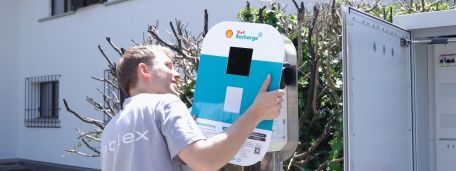
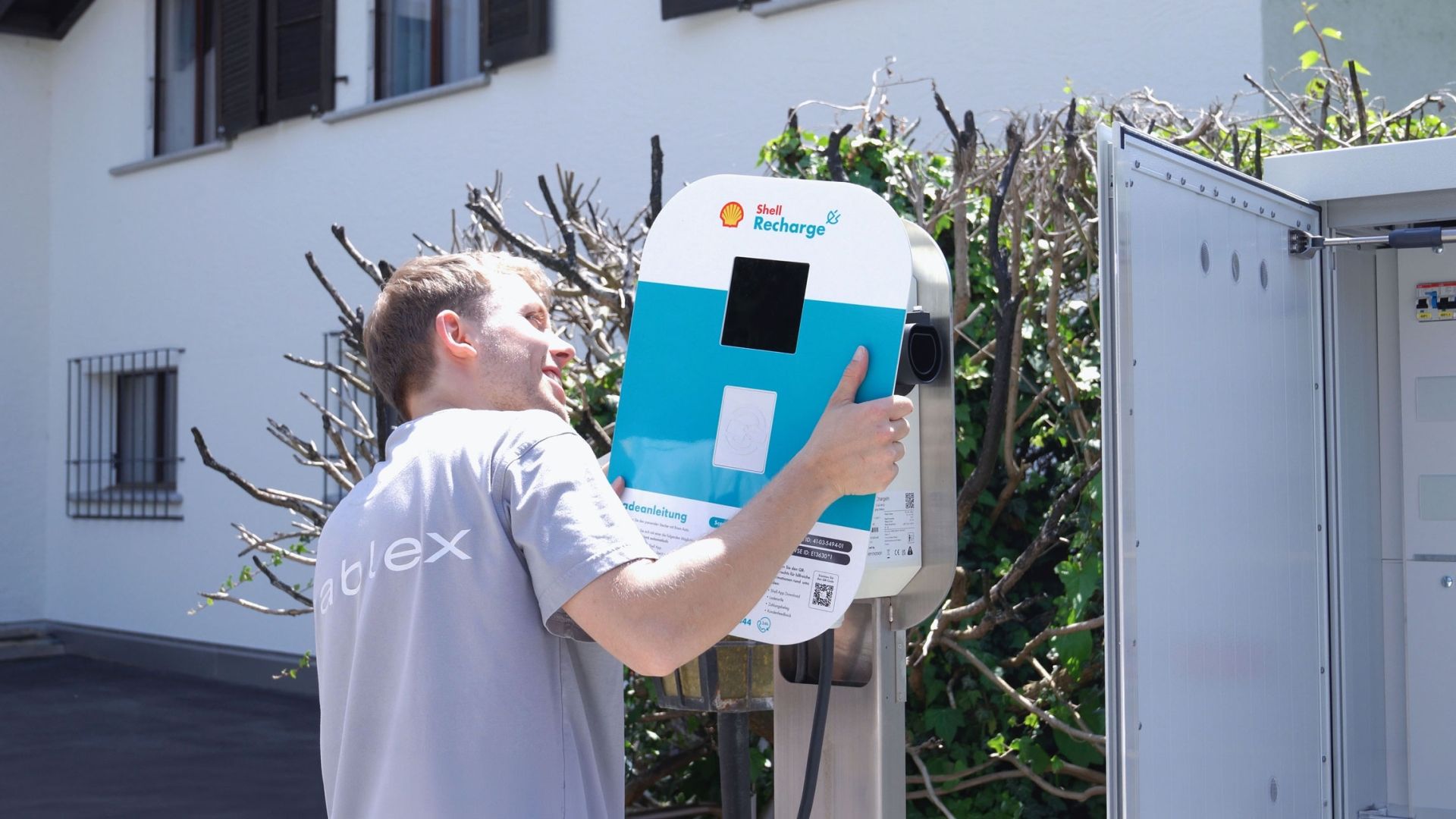
Behind the Hotel/Restaurant Chartreuse AG in Hünibach, directly on the shores of Lake Thun, evpass AG has operated three public charging stations since completion: two fast chargers with 66 kW output each and one standard charging station with 11 kW. The two public fast chargers behind the hotel are thus likely among the most powerful public charging points in the area — sufficient to fully charge an electric vehicle in around one hour.
The installation has its own direct grid connection from regional energy provider BKW: 200 amperes of continuous load guaranteed, expandable to 250 amperes. This is not a peripheral technical detail, but the true backbone of this story.
When the original plan fell through
Charging infrastructure projects rarely begin with the perfect solution on the drawing board — they begin with an idea that has to prove itself in practice. The original plan was to connect the charging stations to the grid via the adjacent hotel: a logical approach, given that the infrastructure already seemed to be in place on site. It was only during detailed planning that the true complexity of a connection via the hotel became apparent — reason enough to explore an alternative.
For many projects, this would be the moment when delays, cost overruns and endless coordination loops begin. At cablex, it was the moment when the real project work truly got under way.
Daniel Berger, Project Manager at cablex:
Daniel Berger, project manager at cablex, went on site to develop an alternative. Together with grid operator BKW, it was assessed whether the charging stations could be supplied independently of the hotel via a standalone direct connection. BKW judged the solution to be feasible — and the result ultimately exceeded the original plan: the new independent connection proved technically superior, clean and at the same time more cost-effective than the hotel-based routing originally planned.
The roundabout that became an opportunity
What influenced the project positively was a convergence of circumstances that cablex turned to systematic advantage: at the same time, the existing road junction near the hotel car park was being converted into a roundabout. These works required the relocation of existing power supply lines in any case. During the assessments it emerged that BKW also wanted to prepare civil engineering work in the rear section — towards the hotel car park.
cablex recognised the potential of this overlap and coordinated the work so that both projects could be completed in a single construction phase. Along the hotel access road, two cable conduits were laid simultaneously: one for the power supply to the charging stations, one for adapting BKW's infrastructure to the new roundabout configuration. This saved time, prevented duplicate excavation work and reduced disruption for all parties — from the grid operator to the hotel, whose car park access was affected only once rather than twice.
An example of effective stakeholder management: the excavation work along the hotel access road was deliberately scheduled during the school holidays — the hotel's low season — to keep disruption to guests and operations to an absolute minimum.
A ventilation shaft, a crane and a 42-metre boom
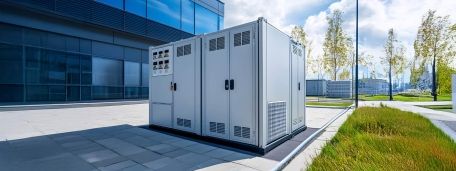
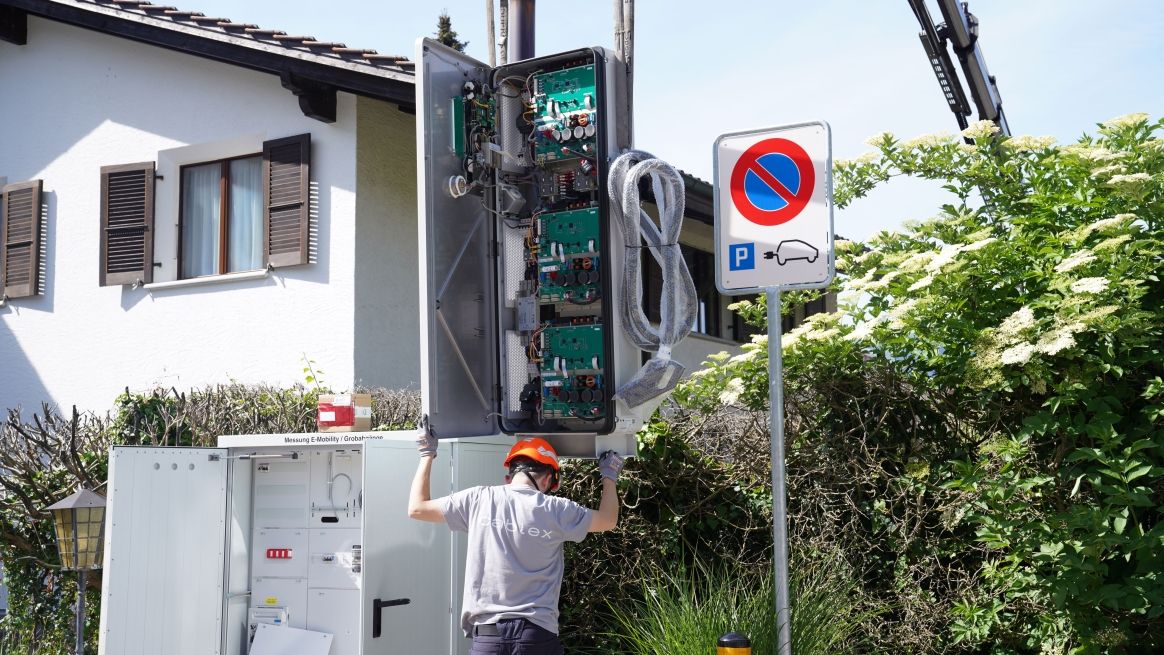
Structural surprises were not long in coming either. In the hotel's entrance area, a ventilation shaft crosses the access route to the car park — rated for a maximum load of around 3.5 tonnes. A loaded lorry carrying the distribution cabinet (500 to 600 kilograms) or the charging stations would have significantly exceeded this limit.
The solution was as straightforward as it was impressive: rather than driving through the car park, the distribution cabinet and charging stations were lifted and installed directly from the road using a mobile crane with a 42-metre boom — with precision, without compromise and without any risk to the existing infrastructure.
Clear responsibilities, a single point of contact
Projects involving multiple parties rarely fail for technical reasons — they most often fail at the interfaces. In Hünibach, overall project management remained with cablex throughout: from preparing the quotation and obtaining building permits, to coordinating with the hotelier as landlord of the parking area, liaising with BKW and through to the fully operational handover to evpass.
Task allocation at a glance:
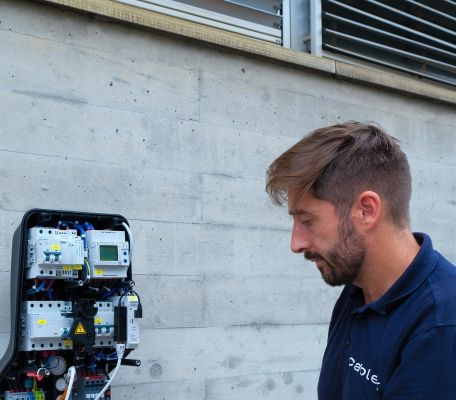
- cablex: project management, building permits, coordination of all companies involved, civil engineering, laying of cable conduits, connection of charging stations, installation on prepared foundations
- BKW: cable pull from the grid to the installation, connection and assembly of the distribution cabinet, meters and current transformers, adaptation of existing infrastructure to the new roundabout configuration
- evpass AG / Shell: client, delivery and commissioning of the charging stations
For the client, this model meant above all one thing: a central point of contact for all project phases — from the initial quotation to the operational installation — and no need to act as intermediary between civil engineering contractors, grid operator and authorities. The charging infrastructure itself belongs to Shell/evpass as client and operator of the installation — the hotel provides the parking area exclusively.
Daniel Berger, Project Manager:
"Complex projects don't need an administrator. They need a partner who takes ownership, develops solutions and guides all parties safely to the finish line."
What this means for your project
The Hünibach project is not an isolated case, but representative of the reality of many EV charging infrastructure projects in Switzerland: whether it is operators such as Shell/evpass, municipalities looking to create public charging points, or hotels and hospitality businesses wanting to offer charging to their guests — the challenges are similar. Grid connections are rarely as straightforward as they look on paper. Permitting procedures, ownership structures and parallel construction projects in the vicinity all affect timelines and budgets. And in the end, what counts is whether a project partner is capable of responding to unexpected situations with real solutions.
That is precisely the standard to which cablex holds itself when delivering charging infrastructure: from the first site and grid assessment through coordination with the grid operator to the fully operational handover — one point of contact, one responsibility, one solution.
Your own charging infrastructure project?
Whether it is a public fast charger, a fleet charging solution or charging infrastructure for your property: cablex supports you from the first site and grid assessment through to ongoing operations. Contact our Smart Energy team for a no-obligation initial assessment of your project.
Do you need our advice?
Start free and hassle-free. In a 45-minute on-site meeting, we analyse your current situation and discuss your goals. Based on this, we create your master plan.